Korea in July: Weather, What to Wear & Things to Do
July is when summer in Korea becomes serious.
But there is something I want travelers to understand before imagining the entire month as one long stretch of rain and unbearable heat:
July changes as it goes.
Early July can still give you perfectly enjoyable summer days. Seoul is intensely green, the days are long, and summer is in full swing.
As the month progresses, however, the atmosphere changes.
The rainy season becomes an important factor. Humidity rises. Even when it is not raining, the air can begin to feel heavy and damp.
And as Korea moves deeper into midsummer, the heat becomes increasingly noticeable.
For me, July is the month when summer gradually turns up the dial.
Then comes August.
That is when the full steamer-like heat really begins.
Is July a Good Time to Visit Korea?
Yes, but July would be near the bottom of my personal ranking if weather were the only consideration.
That does not mean I think you should avoid Korea in July.
Summer vacation is summer vacation. Families have school schedules. Flights work when they work. Sometimes July is simply when you can come.
And you can absolutely have a great trip.
You just need to travel differently.
For me, the hardest part of July is not necessarily the temperature.
It is the humidity.
There are days when I look outside and think, It’s not raining. Let’s walk.
Then I step outside.
And the air seems to wrap itself around me.
My clothes stop feeling fresh much faster than they did in June. The same walk somehow feels longer. And suddenly that air-conditioned café across the street looks extremely attractive.
That is why I approach July with a simple rule:
I always have an indoor alternative.
Not because I expect the day to go wrong.
Because in July, changing the plan is part of the plan.
July in Korea at a Glance
Weather: Hot and humid summer weather, with Korea’s rainy season an important factor during the month.
Best for: Travelers who can be flexible, Korean summer food, shopping, cafés, indoor experiences, evening activities, and mixing shorter outdoor sightseeing periods with air-conditioned breaks.
Think twice if: You strongly dislike humidity, heavy rain, or changing your itinerary according to the weather.
What to pack: Lightweight breathable clothing, comfortable shoes that can handle wet streets, sunscreen, sunglasses, a compact umbrella, and a very light layer for strongly air-conditioned interiors.
Rain: July is a month when Korea’s rainy season genuinely matters, but jangma does not mean nonstop rain every day.
My take: July is absolutely manageable. Just do not expect to spend ten uninterrupted hours outdoors every day.
What July Really Feels Like in Seoul
July and August in Seoul can feel almost subtropical to me: hot, humid, intensely green, and sometimes suddenly very wet.
But July does not begin at maximum intensity.
Early July
Early July can still surprise you with decent summer weather.
It is hotter than June, but there can be perfectly good days for sightseeing.
If the rainy-season pattern is relatively quiet, I can still spend plenty of time outside.
The trees are thick with summer leaves, the city is lively, and the long evenings can be enjoyable.
So if you are arriving in early July, I would not read a description of Seoul in early August and assume that is exactly what your trip will feel like.
It may not.
Mid to Late July
This is when I notice the summer becoming more demanding.
Humidity becomes increasingly difficult to ignore. Rainy-season weather can become a genuine planning factor, and even when it is not raining, moisture in the air can make the heat feel more tiring.
That is the strange thing about July.
Sometimes the temperature on your phone does not look terrifying at all.
But after walking outside for an hour, you understand.
Humidity changes the experience of heat.
July Weather in Korea: Heat, Humidity and Rain
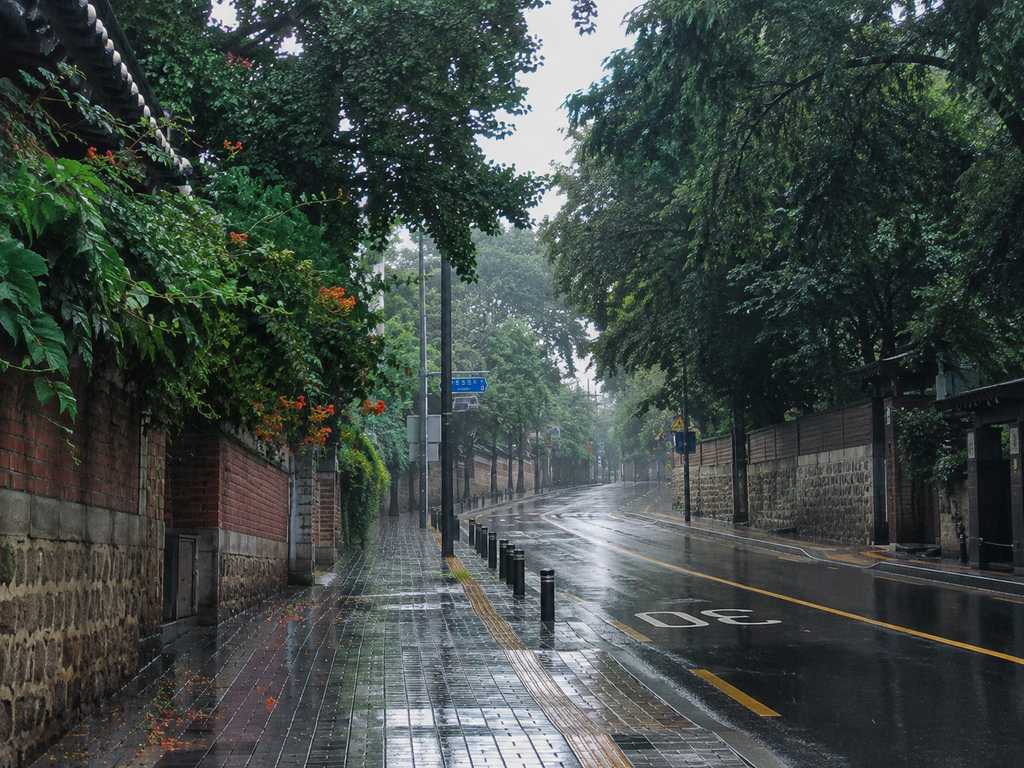
July sits firmly inside Korea’s hot and wet summer season.
If you are planning a trip, I would pay attention to more than the daily high temperature.
Look at the temperature, humidity, chance of rain, and hourly forecast together.
A hot day with high humidity can feel very different from the same temperature in dry air.
That is also why comparisons with June can be misleading.
The number on the weather app may not look dramatically different.
The air can.
July is also one of the wetter periods of the year in Korea as the summer rainy season affects the country.
But climate averages cannot tell you exactly what your particular week will look like.
One year may bring concentrated periods of very heavy rain. Another may give you more breaks between rainy spells.
Use climate averages to understand the season, but use the current forecast to plan the actual day.
Jangma: Korea’s Summer Rainy Season
Korea’s summer rainy season is called jangma.
Its exact start, end, and intensity vary from year to year and by region, so I would never plan a trip around an exact assumption about when the rain will begin or finish.
One important misconception is that jangma means rain falling continuously every day for weeks.
It does not necessarily work like that.
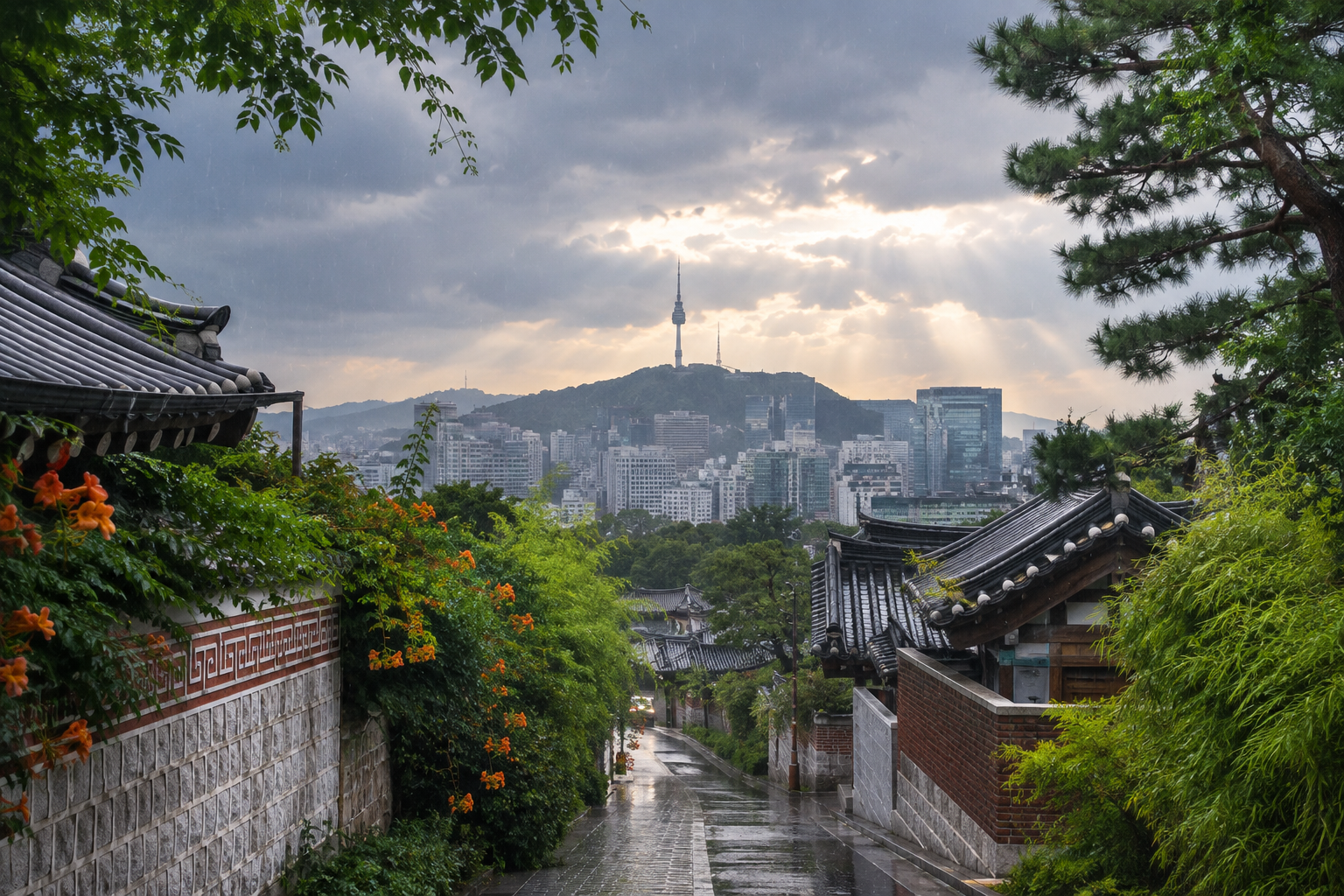
You can have a period of heavy rain, followed by a break, then a humid gray day, sunshine, and another intense downpour.
Sometimes the rain can be genuinely heavy.
That unpredictability is why I do not plan a July trip around assumptions such as, “It probably won’t rain until evening,” or, “The rainy season should definitely be finished by this date.”
Instead, I check the weather close to the actual day and keep parts of the itinerary movable.
Always Have an Indoor Alternative
This is probably my most practical advice for Korea in July:
Always have an indoor alternative ready.
And I do not mean sitting in your hotel waiting for the weather to improve.
Seoul is one of the easiest cities in which to turn an indoor day into an actual travel day.
If heavy rain arrives or the humidity becomes exhausting, change direction.
Go shopping. Have a long lunch. Visit a museum or exhibition. Explore Korean beauty products. Spend a few hours in a large shopping complex. Find an unusual experience café. Have dessert.
Then go back outside later if the weather improves.
Try One of Korea’s Unusual Cafés
Korean café culture is much bigger than coffee.
There are cafés built around crafts, drawing, making accessories, games, desserts, animals, and other hands-on experiences.
Some are activities in their own right.
These are exactly the kinds of places I keep in mind for July.
Instead of suddenly wondering what to do when the rain begins, you already have somewhere indoors that you genuinely wanted to visit.
That is the difference.
Use Seoul’s Big Shopping Complexes
Large shopping destinations can also be extremely useful in midsummer.
Places such as COEX, The Hyundai Seoul, and Lotte World Mall combine shopping, restaurants, cafés, and entertainment in one air-conditioned environment.
I would not spend every beautiful July day inside one.
But when the weather is miserable, they become very useful.
You can eat well, browse Korean brands, shop, cool down, and move the outdoor part of your itinerary to a better time.
In July, I never think of an indoor plan as Plan B. I plan it alongside Plan A.
That is how I actually handle Korean summer.
What to Wear in Korea in July
Pack for heat and humidity.
Lightweight T-shirts, loose shirts, breathable dresses, shorts, skirts, and light trousers are all useful.
I prefer clothes that remain comfortable when I am warm and that will not become miserable if they get slightly damp.
Shoes matter too.
July is not the month when I want my entire sightseeing wardrobe dependent on shoes that cannot survive wet pavement.
I would pack lightweight summer clothing, comfortable walking shoes, sunscreen, sunglasses, a compact umbrella, a small handkerchief or towel, and a refillable water bottle.
I would also bring one very light cardigan or overshirt.
Korean buildings can be heavily air-conditioned in summer, so it is entirely possible to feel hot outside and surprisingly cold indoors.
The Best Things to Do in Korea in July
July is when I deliberately mix indoor and outdoor Korea.
Use Good Weather for Outdoor Seoul
If you wake up to a decent forecast, use it.
Visit a palace. Walk through a neighborhood. Explore a traditional market. Take the outdoor photos you wanted.
Do not necessarily save your most weather-dependent plans for three days later simply because that was the original itinerary.
July rewards flexibility.
Break Long Sightseeing Days Into Pieces
I would not automatically plan a palace, traditional village, market, park, and Han River visit as one enormous outdoor marathon.
Go somewhere.
Cool down.
Eat.
Do something indoors.
Then continue.
You will probably enjoy the outdoor portions much more.
Keep an Indoor Experience Ready
This is where unusual Korean cafés, museums, exhibitions, beauty experiences, shopping, and hands-on activities earn their place.
They are not emergency shelters.
They are part of experiencing Korea.
July is a good month to deliberately include them.
Make Food and Shopping Part of the Day
Shopping is part of Seoul.
Korean fashion, beauty, stationery, food, accessories, department stores, and malls can all be genuine travel experiences.
The same goes for food.
A long lunch, dessert, or café stop does not have to be dead time between attractions.
On a humid or rainy July afternoon, it can be exactly what makes the rest of the day enjoyable.
Go Back Outside in the Evening
If the rain stops or the heat eases, go back out.
July evenings can still be lively and enjoyable.
The goal is not to hide indoors all day.
It is to move between indoor and outdoor Seoul according to what the weather is doing.
Sambok: Korea’s Hottest Season
July also brings Korea into Sambok, the traditional midsummer period associated with the hottest days of the year.
The three Bok days are called Chobok, Jungbok, and Malbok, and their exact dates change each year.
If you are in Korea during this period, you may notice one particularly famous food tradition.
Samgyetang.
Samgyetang is a hot chicken soup traditionally prepared with ingredients such as glutinous rice, garlic, jujube, and ginseng.
Eating it on a Boknal is a well-known Korean summer custom, based on the idea of restoring energy during exhausting summer heat.
So if you pass a samgyetang restaurant on a very hot day and see people lining up for steaming chicken soup, there is a reason.
Korea has a traditional expression for this idea: fight heat with heat.
It is one of those customs that may seem slightly strange until you experience a Korean summer yourself.
And Then Comes Chal-Oksusu
There is another food that tells me serious summer is approaching:
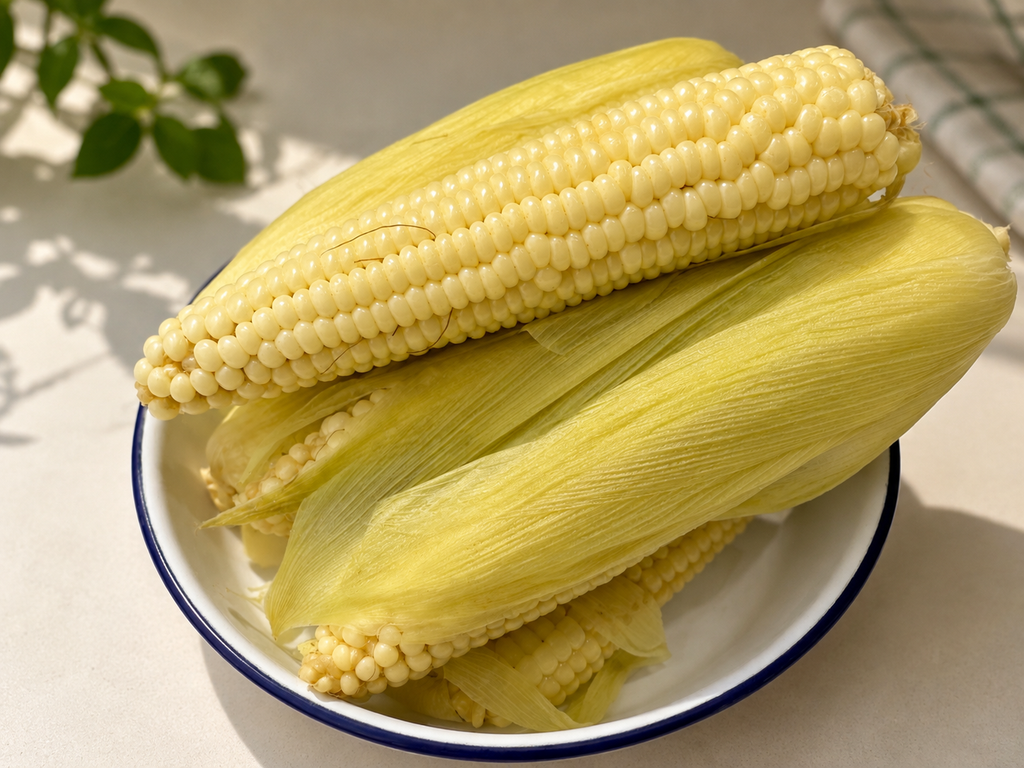
찰옥수수, or chal-oksusu, Korean glutinous corn.
As July progresses toward the hotter part of summer and into August, steamed corn starts to feel very seasonal to me.
Korean chal-oksusu is not necessarily like the very sweet yellow corn some international visitors expect.
It is known for a pleasantly chewy, dense texture.
And I strongly associate it with midsummer.
There is also something very appropriate about the timing.
The weather is becoming steamy.
And Korean kitchens are steaming corn.
You peel it while it is still warm and eat it kernel by kernel.
Nothing about this is a major tourist attraction.
And that is precisely why I want to tell you about it.
Sometimes the most memorable way to experience a Korean season is simply to eat what Koreans are eating.
July vs. August: They Feel Different to Me
I would not lump July and August together as one identical block of Korean summer.
For me, the progression matters.
July is when summer becomes increasingly humid, rainy, and demanding.
By the latter part of the month, the serious midsummer feeling becomes much stronger.
Then comes early August.
That is when I personally start using the Korean expression jjimtong-deowi, which literally evokes the feeling of being inside a steamer.
Hot, humid air seems to surround your entire body.
So if your trip is in early July, do not automatically assume you will experience the same conditions I describe for early August.
If you arrive at the very end of July, however, you are getting much closer to Korea’s most intense summer weather.
The Pros and Cons of Visiting Korea in July
Why July Can Still Be Worth It
Korea is intensely green.
Summer food culture is in full swing.
The city is lively.
There are excellent indoor experiences.
And July lets you see a version of everyday Korean life that spring and autumn travelers may never experience.
Umbrellas drying outside cafés.
Everyone carrying iced drinks.
People escaping into air-conditioned department stores.
Samgyetang restaurants filling on Boknal.
Fresh corn appearing as summer deepens.
The collective relief of stepping into a cool subway station.
This is Korea too.
Why I Would Choose Another Month
If weather were my only consideration and I could freely choose any month, July would not be high on my list.
Humidity is the biggest reason.
Heavy rain can interfere with outdoor plans.
Walking becomes more tiring.
And the heat becomes increasingly important as the month progresses.
But there is a big difference between saying July is not my favorite month for weather and saying you should not visit Korea in July.
I would never tell you the second.
My Verdict: Should You Visit Korea in July?
If July is when you can visit, come.
Just do not fight the season.
Check the weather.
Keep plans movable.
Use the subway.
Take air-conditioned breaks.
Have an indoor activity you genuinely want to do.
Eat something good.
Go shopping.
Wait out a downpour over dessert.
Then go back outside.
You do not need every hour of your trip to have perfect outdoor sightseeing weather for the trip itself to be wonderful.
And remember that July changes as it progresses.
Early July can still give you perfectly enjoyable summer days.
Later July increasingly brings the humidity, rainy-season weather, and heat associated with serious Korean summer.
Then August arrives, and that is another story.
For July, do not fight Korean summer. Work with it.
July in Korea: Quick Travel Tips
Always have an indoor alternative. This is my number-one July rule.
Check the hourly forecast. A single daily weather icon is not enough.
Do not underestimate humidity. It can be more tiring than the temperature itself.
Use air conditioning strategically. Cafés, lunch, museums, shopping, and subway rides can break up a long day.
Keep outdoor plans movable during jangma. Switch the order rather than giving up on them.
Carry a compact umbrella. In July, it deserves a permanent place in your bag.
Pack breathable clothing. You will appreciate it.
Try samgyetang during Sambok. It is one of Korea’s best-known midsummer traditions.
Look for chal-oksusu as summer deepens. Korean seasons are experienced through food too.
Frequently Asked Questions About Korea in July
Is July a good time to visit Korea?
You can absolutely have a good trip in July, but it is not one of my favorite months for weather. Humidity, rainy-season conditions, and increasing heat make a flexible indoor-outdoor itinerary especially useful.
Is Korea very hot in July?
Yes. July is hot, but the experience becomes more intense as the month progresses. Late July moves Korea closer to its peak midsummer heat.
Is July rainy season in Korea?
Yes. July falls within Korea’s summer rainy-season period. However, jangma does not mean continuous rain every day, and its exact timing and rainfall patterns vary from year to year.
Does it rain every day in Korea in July?
No. July can have heavy rain and very wet periods, but there can also be breaks and sunny days.
Is Seoul humid in July?
Yes. Humidity is one of the things I notice most in July and can make otherwise ordinary summer temperatures feel much more tiring while sightseeing.
What should I wear in Korea in July?
Wear lightweight, breathable summer clothing and comfortable shoes that can handle wet streets. Bring sunscreen and a compact umbrella, plus a very light layer if you tend to get cold in air-conditioned spaces.
What can I do in Seoul when it rains?
Keep indoor experiences you genuinely want to do on your itinerary: unusual cafés, museums, exhibitions, Korean beauty shopping, department stores, malls, restaurants, and hands-on activities. Then move outdoor sightseeing to a better weather window.
What is Sambok?
Sambok refers to Chobok, Jungbok, and Malbok, three traditional days associated with the hottest period of Korean summer. Eating samgyetang is one of the best-known Boknal traditions.
What is chal-oksusu?
Chal-oksusu is Korean glutinous or waxy corn, known for its chewy texture. Freshly steamed chal-oksusu is a simple seasonal food I strongly associate with midsummer.
Is June or July better for visiting Korea?
For weather alone, I would choose June. June usually gives me more comfortable outdoor days, while July brings more humidity and rainy-season uncertainty.
Is July or August better for visiting Korea?
If sightseeing weather were the only consideration, I would generally choose earlier July over early August. August is when Korea’s full steamer-like midsummer heat becomes much more established.
Still Deciding When to Visit Korea?
Compare July with every other month in my Best Time to Visit Korea: Month-by-Month Guide.
Visiting a little earlier? Read my complete guide to Korea in June for bright early-summer weather, deep green scenery, and long evenings in Seoul.
Planning a trip in August?
Read my complete guide to Korea in August for weather, what to wear, tropical nights, and what peak summer really feels like in Korea.