Korea in March: Weather, What to Wear & Things to Do
March in Korea is the beginning of spring—but I would not pack for spring just yet.
This is one of the easiest months to misunderstand when planning a trip to Korea. On the calendar, winter is over. In reality, especially in Seoul, early March can still look and feel surprisingly wintry. Trees may be bare, mornings can be cold, and a sunny afternoon can turn chilly very quickly once the sun goes down.
But March has a feeling that I really love.
After months of Korean winter, the first genuinely mild afternoon feels important. People start walking a little more. Café terraces that looked completely uninviting a few weeks earlier begin to fill. You see people standing in the sun instead of rushing indoors.
Spring has not fully arrived, but everyone is looking for it.
That is why March is one of my hidden favorites. It is not reliably warm, and I would not choose it if your dream trip depends entirely on cherry blossoms. But if you like experiencing the change of a season—the first hints of warmth, longer daylight, early flowers, and that collective sense that winter is finally loosening its grip—March can be a surprisingly lovely time to visit Korea.
It is also a month when flexibility matters. The beginning and end of March can feel quite different, spring air quality can vary from day to day, and blossom timing should never be treated as a guarantee.
So think of March not as full spring, but as Korea waking up from winter.
March in Korea at a Glance
Weather: March is a transition month. Early March can still feel cold and wintry, especially in the mornings and evenings, while late March usually brings noticeably milder afternoons and the first real signs of spring.
Best for: Travelers who enjoy quieter sightseeing, walking on mild days, the beginning of spring, and experiencing Korea between the winter and peak blossom seasons.
Think twice if: Your main reason for visiting is cherry blossoms or consistently warm spring weather. Blossom timing varies every year, and March weather can change quickly.
What to pack: Layers are essential. I would bring a medium-weight coat or light padded jacket, sweaters or knitwear, long pants, and comfortable walking shoes. A scarf is still useful, especially earlier in the month. By late March, you may be able to shed a layer during a sunny afternoon—but you will probably want it again after sunset.
Cherry blossoms: Do not assume that a March trip automatically means cherry blossoms. Southern parts of Korea generally see spring blooms earlier than Seoul, and the exact timing changes every year. If blossoms are important to your trip, check the current year’s forecast rather than planning around a fixed date.
Air quality: Spring can bring days with elevated fine dust or yellow dust. It is not something I would use as a reason to avoid March altogether, but I would check the daily air-quality forecast and keep some flexibility in the itinerary.
My take: March is not Korea at its prettiest yet—and that is part of why I like it. You are catching the country in transition. Come for the feeling of winter ending, not for a guarantee of perfect spring.
What March Really Feels Like in Korea
March is a month of small changes rather than instant spring.
At the beginning of the month, Seoul can still feel like winter has simply become a little less severe. Trees are mostly bare, the air can be sharp in the morning, and people are often still wearing padded jackets and winter coats. If a cold spell arrives, you may wonder why everyone keeps calling this spring.
By the middle of March, though, something starts to shift. The sunlight feels warmer, daylight lasts longer, and on a calm afternoon you may suddenly realize that you have been walking outside for much longer than you would have a few weeks earlier.
This is one of my favorite parts of March in Seoul. After a long winter, people seem to notice a mild day.
You see more people lingering outside with coffee. Park paths become busier. Someone finds a sunny bench and stays there. Heavy coats start opening during the afternoon, even if everyone buttons them right back up once evening arrives.
By late March, the city can begin to look different too. Small flowers and buds appear, patches of fresh green return, and spring starts feeling less theoretical. But I still would not expect every tree to be covered in blossoms—or every day to be warm.
March 1 and March 31 can feel like they belong to two different seasons.
That difference matters when you are traveling. Someone visiting early in the month may experience a mostly bare, chilly Seoul, while a traveler arriving several weeks later could find mild afternoons and the beginning of spring color.
And even then, Korea’s weather does not move neatly in one direction. A beautiful warm afternoon can be followed by a surprisingly cold morning.
That is why I would pack for March with one rule:
Dress for the coldest part of your day, then use layers to enjoy the warmest.
March rewards flexibility. When the weather is beautiful, stay outside longer. Walk along the river, wander through a neighborhood, or sit somewhere in the sun. When a cold or dusty day arrives, move the indoor parts of your itinerary forward instead.
You do not need March to behave perfectly to enjoy it.
Part of the experience is watching Korea slowly become spring.
March Weather in Korea: How Warm Is It?
Seoul March Weather at a Glance
Typical March temperatures in Seoul:
- Average high: around 11°C (52°F)
- Average low: around 2°C (36°F)
- Average temperature: around 6°C (43°F)
These averages can make March sound comfortably springlike, but they do not tell the whole story. Early March mornings can still feel wintry, while a sunny afternoon later in the month can feel surprisingly mild. The difference between the beginning and end of March is one of the most important things to understand when packing for Korea.
March is when Korea begins warming up, but the change is gradual rather than dramatic.
In Seoul, average daily temperatures rise noticeably from February, but mornings and evenings can still be cold. This is especially true early in the month, when a winter coat or padded jacket may still feel completely appropriate.
During the afternoon, sunshine can make the temperature feel much more comfortable. This is where March gets tricky for travelers: you may leave your hotel bundled up in the morning, carry your coat open during the afternoon, and want every layer back again after sunset.
The temperature difference between day and night is one of the reasons I would prioritize layers over a single heavy outfit in March.
And remember that “Korea in March” does not mean exactly the same weather everywhere. Southern cities such as Busan generally move toward spring earlier than Seoul, while mountainous and northern areas can remain colder.
If you are traveling around the country rather than staying only in Seoul, check the forecast for each destination separately instead of using Seoul’s weather for your entire trip.
The practical takeaway: early March can still behave like late winter, while late March can finally begin to feel like real spring.
Can It Still Snow in Korea in March?
Yes, it can—but this is not what I would expect from an ordinary March trip to Seoul.
Cold snaps are still possible, particularly earlier in the month, and snow can occur in some parts of Korea. Mountainous areas naturally hold onto winter conditions longer than central Seoul.
But if you are visiting Seoul in March, I would not plan the trip around snow. By this point, I would be looking for the first signs of spring instead.
If your goal is specifically a snowy Korea experience, January or February—or a dedicated trip to a mountain or ski area—makes much more sense.
March is the month when I start looking down for tiny flowers and up at budding trees instead of checking the forecast for snow.
What to Wear in Korea in March
Packing for March in Korea is all about layers.
If you are visiting in early March, I would still bring a proper coat. A light padded jacket, wool coat, or another warm outer layer will not look out of place at all, especially in Seoul. Mornings and evenings can be cold enough that a thin spring jacket alone may leave you regretting your optimism.
Underneath, I would pack sweaters, knitwear, long-sleeved tops, and clothes that are easy to add or remove throughout the day.
By mid to late March, a sunny afternoon can feel surprisingly pleasant. This is when you may see people in trench coats, lighter jackets, cardigans, or even carrying their outer layer rather than wearing it.
But do not let one warm afternoon convince you that winter clothing has become unnecessary.
Once the sun disappears, the temperature can drop quickly, and a breezy evening can feel much colder than the afternoon suggested.
For shoes, comfortable sneakers or walking shoes are usually the most practical choice. March is a great month for exploring Seoul on foot when the weather cooperates, and you may end up walking much farther than expected.
What I would actually pack
For a typical March trip to Seoul, my suitcase would include:
- a medium-weight coat or light padded jacket
- sweaters or knitwear
- long-sleeved tops for layering
- long pants or jeans
- comfortable walking shoes
- a light scarf, especially for early March
- sunglasses for bright, clear afternoons
- a compact umbrella
If you are coming in late March, I would add a lighter jacket or trench coat—but I still would not replace every warm layer with spring clothing.
The biggest packing mistake in March is dressing for the season you hope to find instead of the weather Korea actually gives you.
Fine Dust and Yellow Dust in March
March can bring beautiful blue-sky days, but spring in Korea also comes with another weather-related consideration: air quality.
Fine dust levels can vary considerably from one day to another, and spring is also a season when yellow dust originating from desert regions in northern China and Mongolia can affect Korea.
That does not mean every March day has poor air quality. You can have wonderfully clear days like the kind that make you want to stay outside until sunset.
But I would check the air-quality forecast each morning in the same way you check the temperature.
On a day with poor air quality, this is where having a flexible itinerary becomes useful. Move a museum, shopping, café, exhibition, or other indoor activity to that day and save your long outdoor walks for clearer weather.
If you are particularly sensitive to air pollution, bringing a well-fitting mask is also worth considering.
I would not avoid March because of fine dust, but I would not ignore it either.
Things to Do in Korea in March
March is not a month when I would build an itinerary around one huge seasonal event. I would use the changing season itself.
When the weather gives you a beautiful day, take advantage of it. Walk farther, stay outside longer, and look for the small signs that Seoul is beginning to wake up after winter.
1. Look for the First Signs of Spring
One of my favorite things to do in March is simply walk.
That may sound too ordinary to put on a travel itinerary, but this is the time of year when an ordinary walk through Seoul starts changing almost day by day.
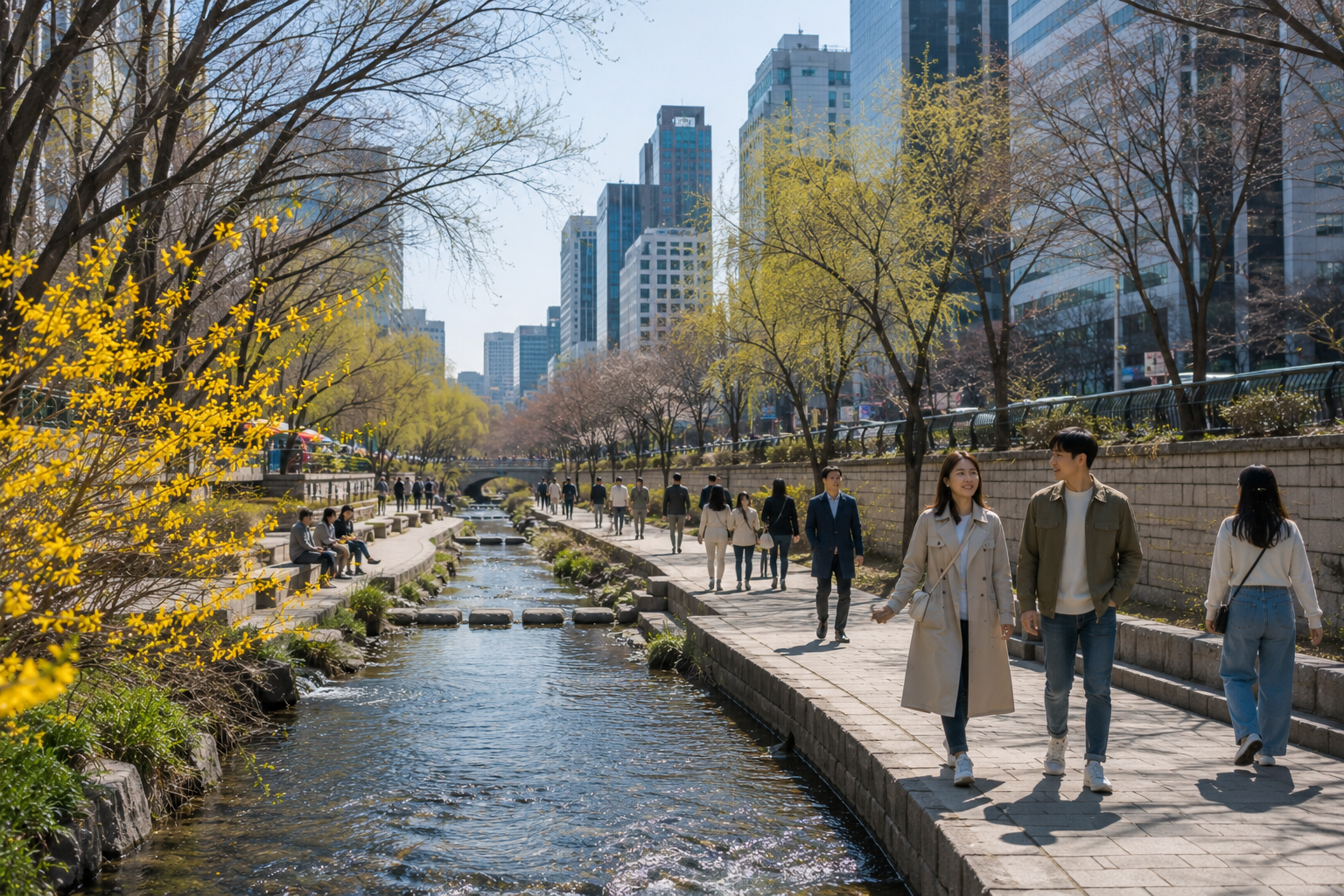
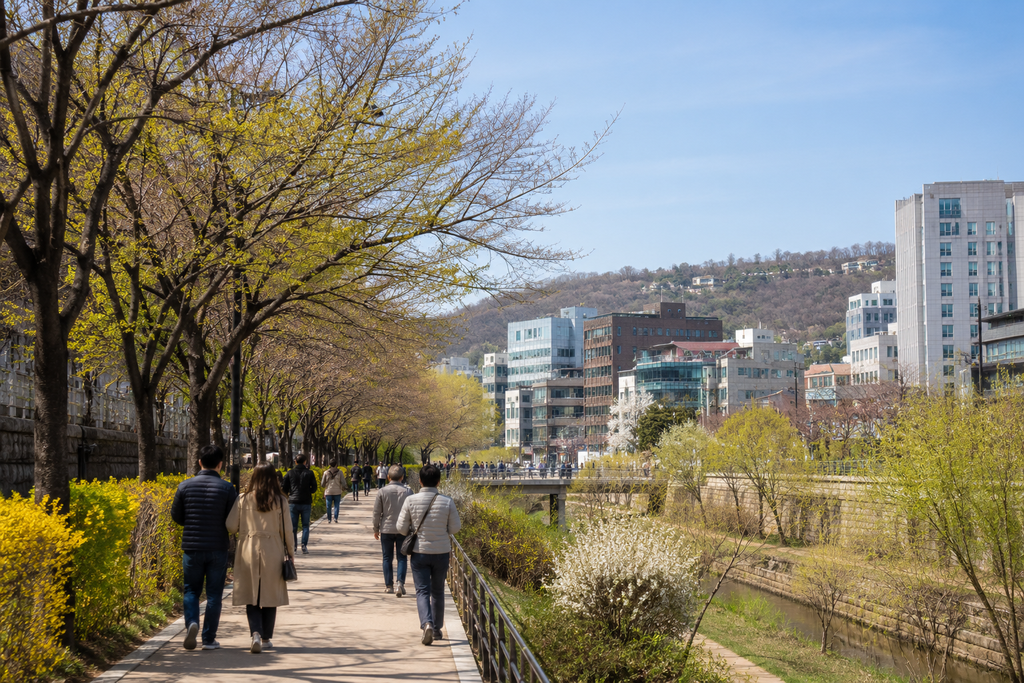
Forsythia begins adding bright yellow along paths and hillsides. Small flowers appear where there was nothing a few weeks earlier. Buds form on trees that still look mostly bare from a distance.
And because the city has been brown, gray, and dormant for months, you notice every bit of color.
You do not need to travel across Seoul searching for one famous flower spot. On a pleasant March afternoon, I would choose an area you already wanted to explore and let spring become part of the walk.
A palace neighborhood, a stream, a park, the paths around a Seoul neighborhood, or even the walk between two places on your itinerary can suddenly feel completely different when the first flowers begin appearing.
This is also why I would leave some empty space in a March itinerary.
If the forecast gives you a clear, mild afternoon, use it.
Stay outside. Walk one more block. Sit somewhere in the sun. Get a coffee and drink it slowly instead of immediately moving to the next attraction.
In Korea, there is a word you will hear often in spring: 꽃구경 (kkot-gugyeong)—literally, going out to look at flowers.
It does not have to mean standing underneath thousands of cherry blossoms.
In March, sometimes the fun is simply finding the first ones.
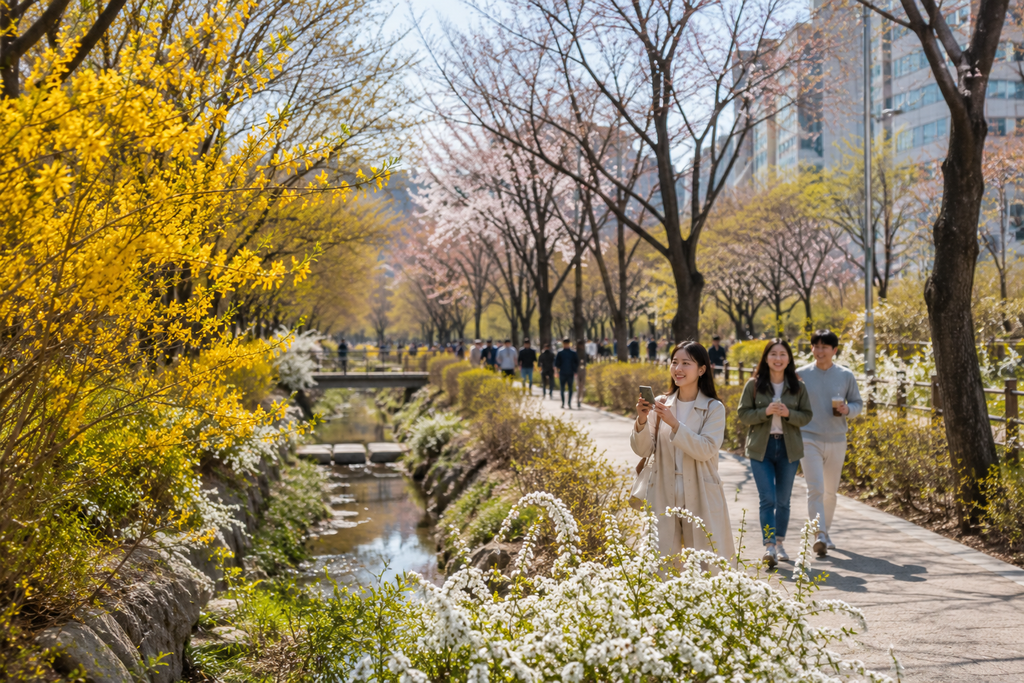
2. Take Advantage of Korea’s Walking Weather
March can be one of those months when walking suddenly becomes enjoyable again.
In the middle of winter, I often think about how quickly I can get from one warm place to another. By March, a mild and clear day can completely change the way I move through Seoul.
Instead of taking transportation for every short distance, this is when I start wanting to walk.
For travelers, that can be a wonderful way to experience the city. Seoul is full of neighborhoods where the interesting part is not necessarily one attraction, but everything you notice between them—small cafés, bakeries, local shops, residential streets, markets, parks, and ordinary pieces of daily life.
On a pleasant March day, I would choose one part of the city and explore it slowly rather than trying to cross Seoul several times to check attractions off a list.
The same applies outside Seoul. If your itinerary includes a historic city, a coastal area, or somewhere with walking trails, March can be much more comfortable for exploring than the heat and humidity that arrive later in the year.
There is one important condition, though:
Check the weather and air quality before you commit to a long outdoor day.
March is not consistent enough for me to schedule every outdoor activity weeks in advance. If Tuesday turns out to be clear, sunny, and mild while Wednesday looks cold or dusty, I would happily swap the two days.
That flexibility can make a March trip much better.
3. Enjoy Palaces Before Peak Spring Crowds
March can be a lovely time to visit Korea’s palaces, especially on a clear day.
The gardens may not yet have the lush color you would see later in spring, and early in the month many trees can still look bare. But that quieter, more restrained landscape has its own atmosphere.
There is also a practical advantage: walking around a large palace complex can be far more pleasant in cool March weather than under the intense sun and humidity of summer.
If you plan to wear hanbok, however, remember that the calendar saying “spring” does not mean you will feel warm.
I would pay particular attention to the forecast and choose layers that can work underneath the outfit, especially in early March. Standing still for photos can feel much colder than walking.
And this is another place where I would resist chasing the perfect blossom photograph.
A palace does not need to be surrounded by pink flowers to be worth visiting.
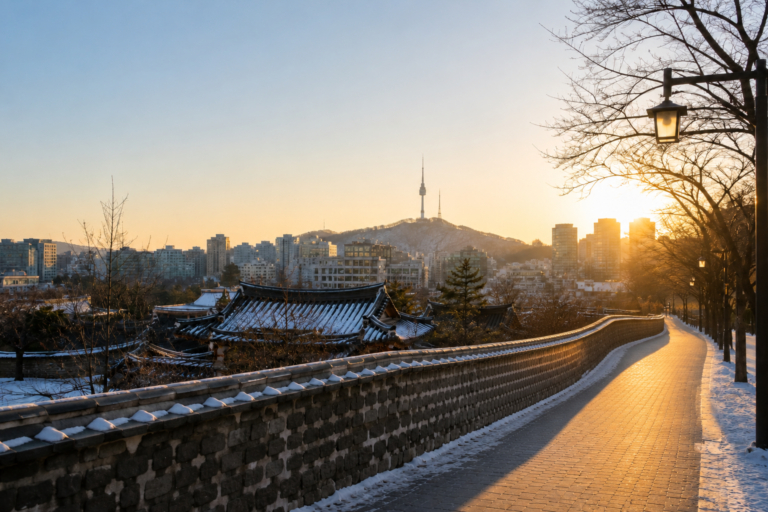
Sometimes bare branches, blue sky, tiled roofs, and the first few signs of green tell the season much more honestly.
4. Don’t Chase Cherry Blossoms Too Early
If cherry blossoms are the main reason for your trip, March requires a little caution.
Spring does not arrive everywhere in Korea at the same time. Southern parts of the country generally warm up earlier, while Seoul tends to follow later. And even within the same city, different varieties of blossoms and different locations can bloom at slightly different times.
This is why I would never book a March trip to Seoul assuming, “I’ll be there at the end of the month, so I’ll definitely see cherry blossoms.”
You might.
But you might also arrive a little too early.
Cherry blossom timing changes from year to year depending on weather conditions, and a few unusually warm or cold weeks can shift the experience you find when you arrive.
If seeing blossoms is important to you, check the current year’s bloom forecast as your trip approaches. And if your dates are flexible, avoid building the entire trip around one predicted peak-bloom day.
There is another reason I would not obsess over cherry blossoms in March: they are not the only sign of spring in Korea.
Forsythia, plum blossoms, magnolias, spirea, and other early flowers begin appearing around the country, sometimes while many trees are still bare.
That mixed landscape—winter branches, yellow forsythia, the first white and pink flowers, and people suddenly stopping to photograph them—is actually one of the things I associate most with the beginning of Korean spring.
So if you visit in March, enjoy whatever spring has reached Korea by the time you arrive.
Do not judge the trip by whether the cherry trees cooperated with your flight dates.
If what you really want is Korea in full spring mode, with a better chance of seeing the country transformed by blossoms and fresh green, April may be the month you are actually looking for.
5. Keep One Indoor Day in Your Back Pocket
March is a month when I would avoid planning every day too rigidly.
You may get several beautiful days in a row. But you can also wake up to cold rain, a sudden drop in temperature, or air quality that makes a long outdoor itinerary much less appealing.
So rather than assigning every museum, shopping area, café, or indoor attraction to a specific day before you arrive, I would keep at least one group of indoor activities flexible.
Then check the forecast each morning.
If the sky is clear and the air is good, go outside.
Take the palace walk. Explore a neighborhood. Visit a park. Stay out for sunset.
If the weather turns unpleasant, that is the day to move indoors—visit a museum or exhibition, spend time in a large shopping complex, explore a traditional market, settle into a café, or enjoy one of the many things Korea does very well indoors.
This sounds like a small planning decision, but in a transitional month like March, it can make a big difference.
Instead of asking March to fit your itinerary, let your itinerary move with March.
What to Eat in Korea in March
Spring sometimes arrives on the table before it arrives on the trees.
March can still give you a cold evening when a steaming bowl of soup sounds perfect. But this is also when seasonal greens and lighter spring ingredients begin appearing in markets, restaurants, and home cooking.
In Korea, spring is strongly associated with 봄나물 (bom-namul), a broad term for the young greens and herbs eaten as the season begins to change.
You may come across ingredients such as 냉이 (naengi, shepherd’s purse), 달래 (dallae, wild chives), and 쑥 (ssuk, mugwort) in soups, seasoned vegetable dishes, pancakes, rice cakes, and other foods.
You do not need to memorize those names before your trip.
If you see a restaurant or market advertising 봄나물 or 봄 제철 ingredients, that is simply a clue that the Korean table has started noticing spring too.
And on a genuinely cold March day? I would still happily choose something hot.
That is the nice thing about eating in Korea during a transitional month. You do not have to choose between winter and spring yet.
One meal can be a bubbling stew on a cold evening; another can be fresh spring greens on a sunny afternoon.
March tastes a little like both seasons at once.
The Pros and Cons of Visiting Korea in March
Why I would consider March
March gives you something that January and February cannot: the feeling that Korea is beginning to open up again after winter.
The days are getting longer, mild afternoons become more frequent, walking becomes enjoyable again, and the first flowers and fresh green begin appearing around the country.
It can also be a nice time for travelers who want to explore before the most famous spring scenery—and the attention that comes with it—fully arrives.
You may not get picture-perfect spring every day, but on a clear March afternoon, Seoul can feel wonderful.
And if you enjoy noticing seasonal change rather than simply arriving for the finished result, March has a personality of its own.
Why I might choose another month
March is unpredictable.
Early and late March can feel surprisingly different, temperatures can swing considerably between morning and afternoon, and cold spells are still possible.
Air quality can also affect outdoor plans, so travelers who want consistently clear conditions may find the month frustrating.
And if your dream of Korea is specifically full cherry blossoms, green trees, and reliably mild spring weather, I would choose April rather than trying to force March to deliver it.
March asks for flexibility.
For some travelers, that is part of its charm.
For others, it is a very good reason to come later.
Is March a Good Time to Visit Korea?
Yes—especially from the second half of the month if you enjoy early spring and do not need perfect weather.
I like March because it feels hopeful.
Korea has just come through a long winter, and suddenly small things become noticeable again: warmer sunlight, people staying outside longer, the first flowers beside a walking path, a jacket that can finally stay open in the afternoon.
But I would choose March for that transition itself, not because you expect Korea to look like a spring postcard from the moment you land.
For a first-time traveler who prioritizes comfortable weather and spectacular seasonal scenery above everything else, April or parts of autumn may be easier choices.
For someone who likes quieter seasons, walking, everyday Seoul, and watching a place change in front of them?
March can be lovely.
My Verdict on Korea in March
Come in March if you want to watch spring arrive. Come later if you want to find it already waiting for you.
I would personally favor the second half of March, while still checking the forecast rather than assuming the weather will cooperate.
Pack layers. Keep some indoor plans flexible. Check the air quality. Do not make cherry blossoms responsible for the success of your entire trip.
Then, when Korea gives you one of those clear March afternoons, use it.
Walk farther than you planned.
Look for the first flowers.
Sit in the sun.
That is the March I like.
Frequently Asked Questions About Korea in March
Is March cold in Korea?
March is the beginning of spring, but it can still be cold—especially in Seoul during early mornings, evenings, and the first half of the month. Late March generally feels milder, but cold spells are still possible. Pack layers rather than assuming you will have consistently warm spring weather.
What should I wear in Korea in March?
Bring a medium-weight coat or light padded jacket, sweaters or knitwear, long-sleeved tops, long pants, and comfortable walking shoes. If you are visiting late in the month, add a lighter jacket or trench coat for mild afternoons, but keep warmer layers for mornings and evenings.
Can I see cherry blossoms in Korea in March?
Possibly, depending on where you go, when you visit, and the weather that year. Southern parts of Korea generally bloom earlier than Seoul, while Seoul’s cherry blossom season may extend into April. If blossoms are important to your trip, check the current year’s forecast rather than relying on fixed dates.
Is late March a good time to visit Seoul?
I think late March can be a lovely time to visit Seoul if you are comfortable with changeable weather. Afternoons can become pleasantly mild, the first spring flowers begin appearing, and walking around the city becomes much more enjoyable than in midwinter. I would still bring layers and check the forecast each day.
Is March rainy in Korea?
March is not Korea’s main rainy season, but rain is certainly possible. A compact umbrella is useful, and a rainy or unexpectedly cold day is a good opportunity to move museums, shopping, cafés, or other indoor activities forward in your itinerary.
Is air quality bad in Korea in March?
It varies. March can have beautifully clear days as well as periods of elevated fine dust or yellow dust. Check the daily air-quality forecast rather than assuming the entire month will be either good or bad, and keep some flexibility in your outdoor plans.
Is March a good time for a first trip to Korea?
Yes, particularly if you enjoy walking, early spring, and traveling outside the most famous seasonal periods. But if your priority is reliably mild weather, lush greenery, and a stronger chance of peak spring blossoms, I would choose April instead.
Is March better than April for visiting Korea?
It depends on what you want. March offers the experience of watching winter turn into spring and can feel quieter and less predictable. April generally offers warmer weather, more greenery, and a better chance of classic spring scenery—but it is also a more popular time to visit.
Still deciding when to visit Korea?
Compare March with every other month in my Best Time to Visit Korea: Month-by-Month Guide.
Visiting a little earlier?
Read my complete guide to Korea in February.
Planning a trip in April?
Read my complete guide to Korea in April for weather, what to wear, spring flowers, and what peak spring really feels like in Korea.