Korea in August: Weather, What to Wear & Things to Do
August is when Korean summer reaches full power.
July can be rainy and increasingly humid, but August feels different to me.
The rainy-season story is no longer the main character.
Now it is the heat.
And the humidity.
Especially the humidity.
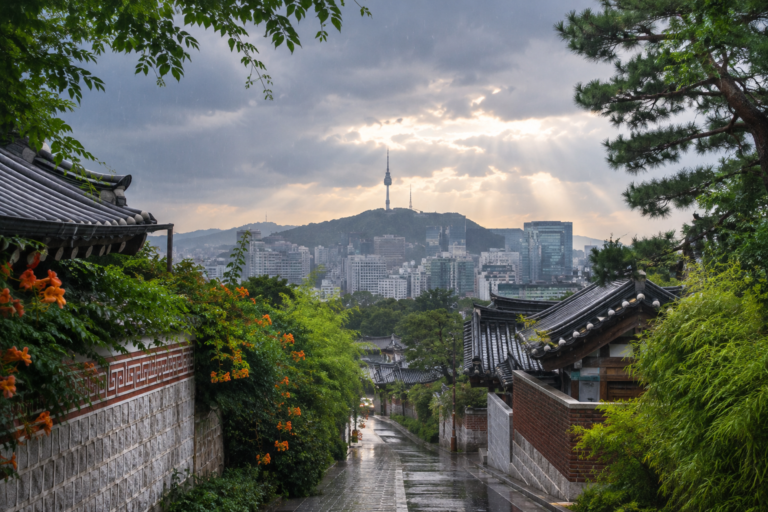
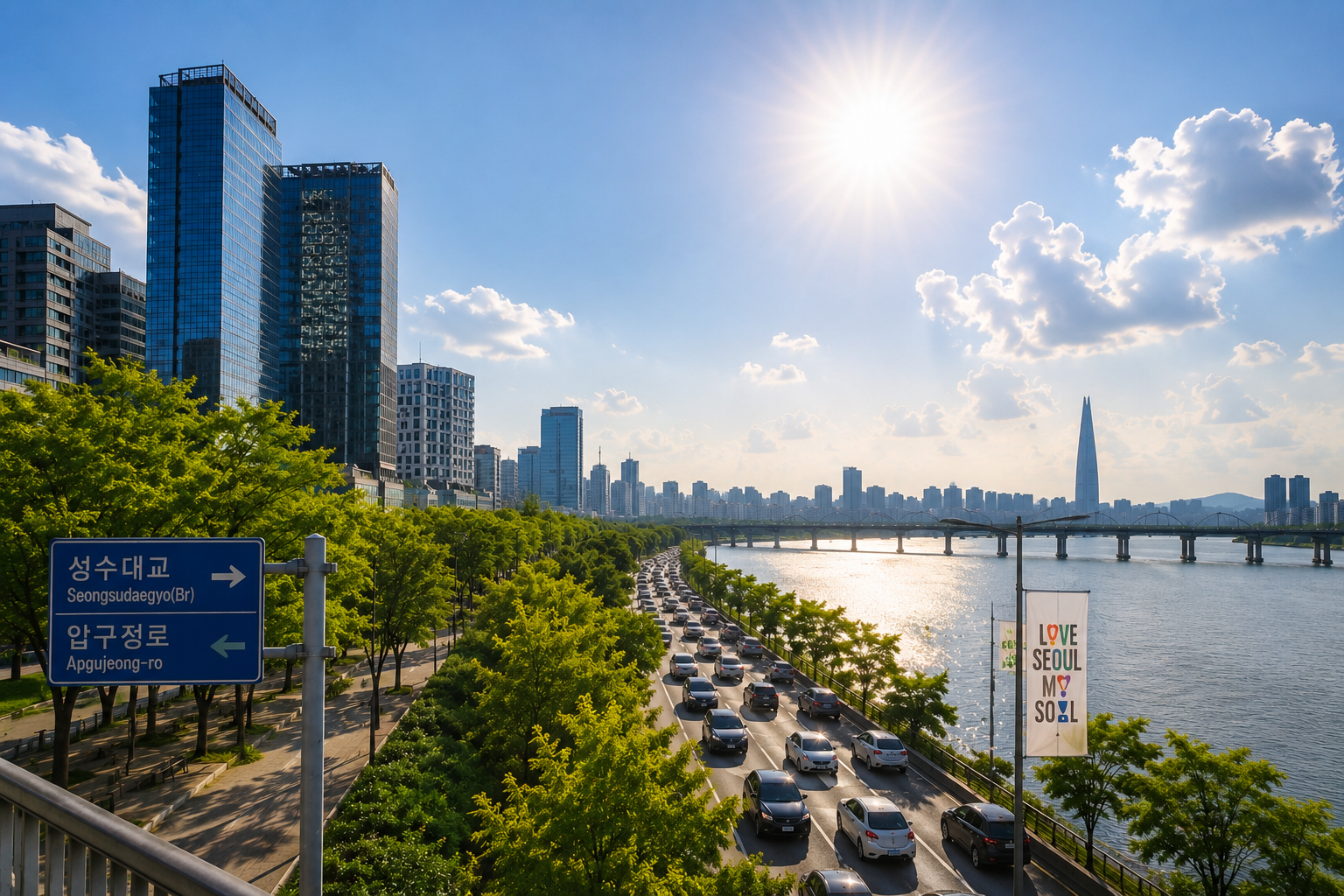
August in Seoul can look beautiful through the window. The trees are deep green, the sky is bright, and on some evenings the clouds turn pink and peach as the sun goes down.
Then you open the door.
And the humidity hits you.
This is the month when I stop trying to build an itinerary around spending the entire day outdoors.
Instead, I work with the heat.
Go outside when the timing is good. Move indoors during the hottest part of the day. Eat something cold. Take advantage of Seoul’s excellent air conditioning. Then come back outside when the sun begins to drop.
Although there is one small problem.
Sometimes the night is hot too.
Welcome to August in Korea.
Is August a Good Time to Visit Korea?
Yes, if August is when you can travel.
But if you asked me to choose the best month to visit Korea based on weather alone, August would be near the bottom of my list.
That is not because Korea stops being enjoyable.
It is because August changes how I use the city.
In spring or autumn, I can happily spend most of the day walking outside.
In August, I would not even try.
The combination of high temperatures and humidity can make long periods of outdoor sightseeing exhausting, particularly around midday and in the afternoon.
So instead of thinking of indoor activities as backup plans, I build them directly into the day.
A palace in the morning.
A long air-conditioned lunch.
Shopping or an exhibition in the afternoon.
Coffee or dessert.
Then back outside in the evening.
August works much better when you stop fighting it.
August in Korea at a Glance
Weather: Hot, very humid midsummer weather, with some of Korea’s most intense heat of the year.
Best for: Travelers who do not mind heat, summer food, shopping, cafés, indoor experiences, evening activities, and a slower sightseeing pace.
Think twice if: You struggle with high humidity, intense heat, or sleeping in hot weather.
What to pack: Very lightweight breathable clothing, comfortable summer shoes, sunscreen, sunglasses, a hat, a compact umbrella, and a light layer for heavily air-conditioned interiors.
Rain: Heavy summer rain is still possible, including sudden downpours and storms, even though the classic jangma period is no longer the only weather story.
My take: August is completely possible, but this is not the month to prove how much sightseeing you can fit into one outdoor day.
What August Really Feels Like in Seoul
If I had to describe August in one word, it would be:
Humid.
The temperature matters, of course.
But humidity is what changes the experience.
You can shower, get dressed, fix your hair, step outside feeling completely fresh, and very quickly wonder why you bothered.
The air can feel thick.
Walking becomes more tiring.
Shade helps, but it does not magically remove the humidity.
And unlike June, when the evening often brings a pleasant sense of relief, August can stay warm long after sunset.
This is Korea’s true midsummer.
August Weather in Korea: Heat and Humidity
August is typically one of the hottest periods of the year in South Korea.
In Seoul, daytime temperatures commonly climb into the 30s Celsius, and hot spells can push temperatures higher.
But again, temperature alone does not tell the whole story.
High humidity can make the heat feel much more intense.
This is why I would pay attention to the feels-like temperature, humidity, heat advisories, and hourly forecast rather than looking only at the daily high.
Strong sunshine is another factor.
If you are sightseeing outdoors, sunscreen, shade, water, and breaks are not optional details.
They are part of the itinerary.
And while Korea’s rainy season is more closely associated with late June and July, August can still bring significant rainfall, thunderstorms, and sudden heavy downpours.
Summer weather in Korea does not become predictable simply because jangma is winding down.
Jjimtong-Deowi: Korea’s Steamer Heat
There is a Korean expression that describes August particularly well:
찜통더위 — jjimtong-deowi.
A jjimtong is a steamer.
So the expression creates a fairly accurate mental image.
You are not simply standing somewhere hot.
You are being steamed.
That is what the combination of heat and moisture can feel like.
For travelers from hot but dry climates, this can be particularly surprising.
A temperature that looks manageable on paper may feel much more exhausting once you begin walking through Seoul.
This is also why I would not compare Korean summer only by temperature with another destination.
Thirty degrees in dry air and thirty degrees in very humid air are two very different sightseeing experiences.
Tropical Nights: When the Heat Stays After Sunset
August has another feature travelers should know about:
Tropical nights.
In Korean weather terminology, a tropical night refers to a night when the minimum temperature remains at or above 25°C.
In practical terms, it means the day ends but the heat does not.
You walk outside after dinner expecting the relief of cool evening air.
Sometimes it never arrives.
The sidewalks are still warm. The air is still humid. People are still holding iced drinks.
And air conditioners continue humming throughout the city.
This is one of the biggest differences between pleasant early-summer evenings and the height of Korean summer.
I still prefer going outside after sunset in August because losing the direct sun makes a huge difference.
I just do not expect the evening to be cool.
How I Plan an August Day in Seoul
My August schedule looks very different from my spring or autumn schedule.
Morning: Use It
If you want to visit a palace, walk through a neighborhood, explore a market, or do anything involving a lot of time outdoors, I would start earlier.
Do not waste a relatively manageable morning sitting inside if you know you want to be outdoors that day.
Midday and Afternoon: Go Inside
This is when I become completely shameless about air conditioning.
Have lunch.
Go shopping.
Visit a museum.
Explore a department store.
Spend time at an exhibition.
Try one of Seoul’s unusual cafés.
Browse Olive Young.
Have dessert.
There is no prize for suffering outside through the hottest part of the day.
And Seoul gives you so many genuinely interesting indoor options that this does not have to feel like wasted travel time.
Evening: Come Back Out
When the sun begins to drop, I go back outside.
Walk through a neighborhood.
Eat dinner somewhere lively.
Visit the Han River.
Explore a night market or shopping district.
Take a slower walk.
August evenings may still be hot, but removing the direct midday sun makes being outside much easier.
This rhythm is probably the single biggest thing I would change about an August itinerary.
Do not organize the day only by location. Organize it by temperature.
The Air-Conditioning Paradox
There is one ridiculous part of Korean summer.
Outside, I am trying not to melt.
Then I enter a café, department store, subway, or restaurant and suddenly I am cold.
The contrast can be dramatic.
This is why I still carry a very light cardigan or overshirt even in August.
Not for outside.
Definitely not for outside.
For inside.
Air conditioning does not cause the common cold itself, but spending hours moving between intense outdoor heat and very cool interiors can feel surprisingly uncomfortable.
It is one of the strange little contradictions of summer in Seoul:
You spend all day trying to escape the heat and somehow end up wishing you had brought a cardigan.
What to Wear in Korea in August
Keep it simple.
Wear the lightest, most breathable clothing you own.
Loose T-shirts, sleeveless tops, lightweight shirts, dresses, shorts, skirts, and very light trousers all work well.
I would prioritize comfort over complicated outfits.
August is not the month when I want heavy denim, thick layers, or anything that becomes unpleasant once I start sweating.
Shoes should also be comfortable enough for walking and practical if a sudden summer downpour leaves the streets wet.
I would pack:
- Lightweight, breathable summer clothing
- Comfortable walking shoes or sandals
- Sunscreen
- Sunglasses
- A hat or cap
- A compact umbrella
- A refillable water bottle
- A small handkerchief or towel
- A very light cardigan or overshirt for air conditioning
And if you care deeply about your hair behaving perfectly all day in humid weather, I would lower expectations.
August has its own plans.
Best Things to Do in Seoul in August
Explore Seoul Early in the Day
Use the morning for your most important outdoor sightseeing.
Palaces, traditional neighborhoods, markets, parks, and walking routes become considerably more pleasant when you are not tackling them during peak afternoon heat.
Turn Shopping Into Part of the Trip
August is a very good month to explore Seoul’s shopping culture.
COEX, The Hyundai Seoul, Lotte World Mall, department stores, underground shopping areas, beauty stores, and smaller neighborhood shops give you plenty to do without spending hours under the midday sun.
And Korean shopping is not merely an escape from the weather.
Beauty, fashion, stationery, food, design, and pop culture are all part of contemporary Seoul.
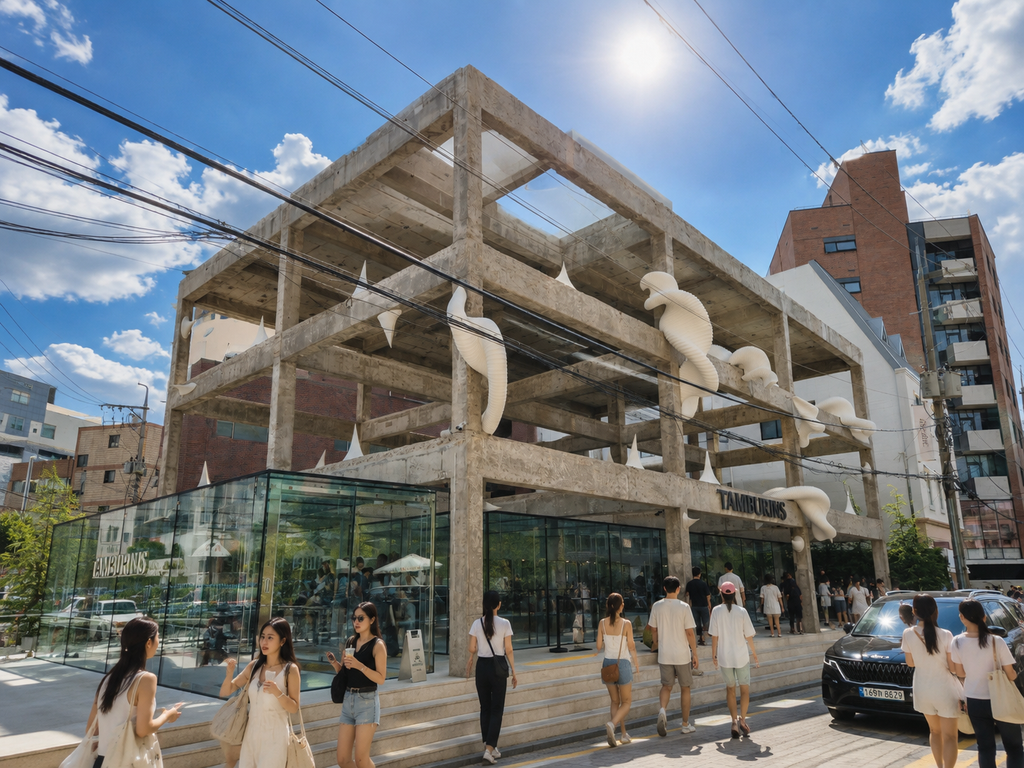
Spend an Afternoon in Seongsu
Seongsu works particularly well for the way I travel in August.
You can walk outside for a while, then move into a café, shop, pop-up, or indoor space whenever the heat becomes too much.
The neighborhood has enough to explore that you do not need to remain outdoors continuously.
Eat Something Cold
Korean summer food deserves its own itinerary.
Naengmyeon, cold buckwheat noodles served in chilled broth or mixed with a spicy sauce, is one of the obvious choices.
Kongguksu, noodles in a cold soybean broth, is another seasonal favorite.
And then there is bingsu.
Shaved ice covered with ingredients ranging from traditional red bean to fruit, mango, matcha, or increasingly elaborate desserts is exactly the kind of food that suddenly makes perfect sense in August.
This is the season when an enormous bowl of ice can feel like a legitimate meal plan.
Enjoy Seoul After Dark
August is a good month to shift some of your sightseeing later.
The Han River, lively shopping streets, restaurant districts, and neighborhood walks all take on a different atmosphere after sunset.
You will still feel the humidity.
But without the direct afternoon sun, I find the city much easier to enjoy.
August Skies: The Beautiful Part of a Brutal Day
For all my complaining about August, the month can give Seoul some beautiful evening skies.
After a hot, humid day, clouds sometimes catch the low evening light and the sky turns peach, pink, lavender, or orange.
I call these my vanilla skies.
There is something almost unfair about it.
You spend the day hiding from the heat, complaining about the humidity, and wondering why you decided to walk anywhere.
Then evening comes.
You look up between the buildings.
And Seoul looks like this.
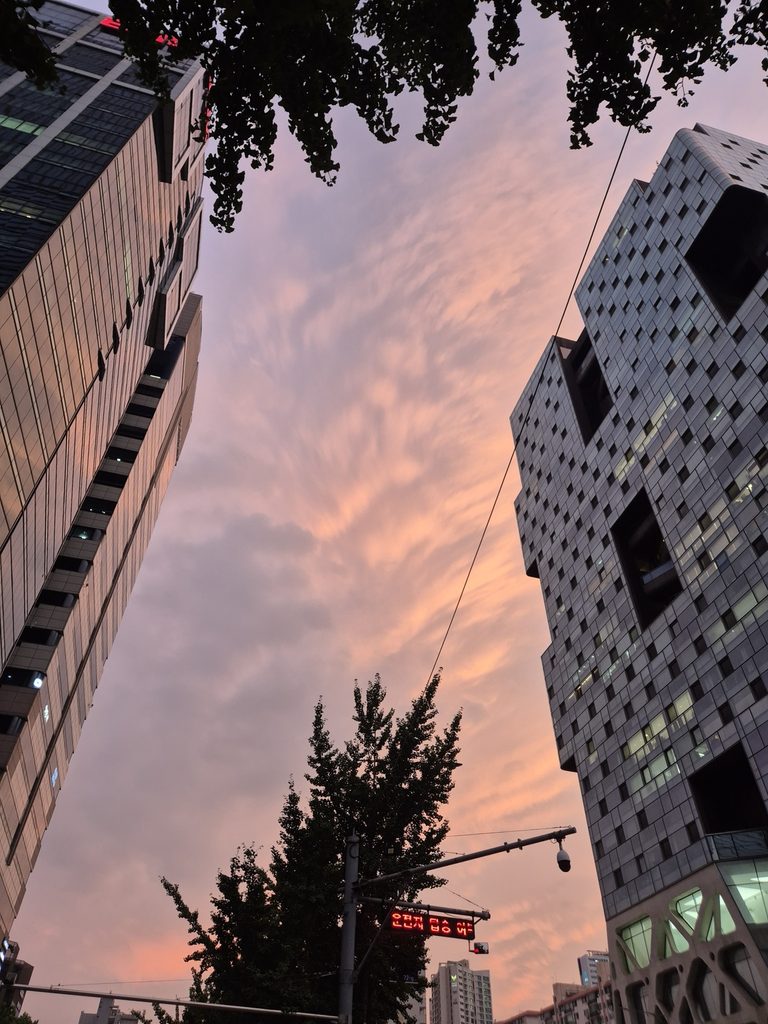
The colors are not caused simply by August humidity. Colorful sunsets depend on the way low-angle sunlight travels through the atmosphere and interacts with particles and clouds.
But whatever combination produced that particular evening, I always notice these skies in summer.
August can be exhausting at street level and beautiful overhead at exactly the same time.
That contradiction feels very August to me.
What to Eat in Korea in August
Summer food in Korea is not limited to cold food.
This is also the season of Sambok, the traditional hottest period of summer, which begins in July and can extend into August depending on the year.
That means samgyetang, Korea’s famous hot chicken soup, remains part of the midsummer food story.
Yes, Koreans eat steaming soup when it is steaming outside.
But August also makes me want foods that cool everything down.
Naengmyeon.
Kongguksu.
Bingsu.
Watermelon.
Cold drinks.
Seasonal fruit.
And the chal-oksusu, Korean glutinous corn, that begins appearing as summer deepens.
Food is one of my favorite ways to experience Korea seasonally.
The weather tells you what month it is.
So does the table.
July vs. August: Which Is Hotter?
For me, August wins.
July can be difficult because of the rainy season, humidity, and increasingly hot weather.
But August is when I expect the full Korean midsummer experience.
The rain may no longer dominate the conversation in the same way, but the heat and humidity take over.
July tells me summer is getting serious.
August tells me summer has arrived at headquarters.
If you are choosing purely for sightseeing comfort, I would generally choose early July over early August.
If you are visiting in August, however, you can still have an excellent trip by changing the rhythm of your day.
The Pros and Cons of Visiting Korea in August
Why August Can Still Be Worth It
Seoul is intensely alive in summer.
The trees are at their fullest green.
Summer food is everywhere.
There are countless indoor things to do.
Evenings remain lively.
And sometimes the sky gives you spectacular sunsets after a brutally hot day.
August also shows you a version of Korea that spring and autumn visitors never quite see.
Iced drinks everywhere.
Portable fans.
People instinctively choosing the shady side of the street.
Air-conditioned cafés becoming temporary refuges.
Cold noodles for lunch.
Bingsu after dinner.
And everyone collectively understanding exactly how hot it is.
This is part of living in Korea too.
Why I Would Choose Another Month
The answer is simple:
Heat and humidity.
If you have complete freedom over your travel dates and your main goal is comfortable outdoor sightseeing, I would choose another month.
April, May, June, October, and parts of autumn offer much easier conditions for spending long days outside.
August requires more breaks and more flexibility.
But difficult weather does not automatically mean a bad trip.
It simply means the weather has to become part of how you plan.
My Verdict: Should You Visit Korea in August?
If August is the month you have available, come.
Just do not plan August like October.
Start earlier.
Use indoor spaces during the hottest hours.
Drink plenty of water.
Take breaks.
Eat cold things.
Carry sunscreen.
Do not underestimate humidity.
And come back outside when the sun starts going down.
You may still encounter a tropical night.
You may discover that your hair has surrendered.
You may walk into a department store and decide you suddenly need three hours of shopping.
That is fine.
August is not a month to conquer.
It is a month to negotiate with.
And every once in a while, after a long, hot, humid day, Seoul will turn the entire sky pink.
Then, briefly, you may forgive August for everything.
August in Korea: Quick Travel Tips
Plan around the hottest hours. Use mornings and evenings for longer outdoor activities whenever possible.
Take humidity seriously. The temperature alone does not describe how August feels.
Check heat and weather alerts. Conditions can change, and heavy summer rain is still possible.
Use indoor Seoul. Shopping, museums, exhibitions, cafés, beauty experiences, and restaurants are part of the trip, not wasted time.
Carry water. Long outdoor walks feel much harder in high humidity.
Use sunscreen even on hazy days. Summer sun can still be strong.
Bring a compact umbrella. Sudden heavy rain remains possible.
Carry one very light layer. Korean air conditioning can be surprisingly cold.
Move some activities to the evening. It may not be cool, but losing the direct sun helps enormously.
Try Korean summer food. Naengmyeon, kongguksu, bingsu, samgyetang, seasonal fruit, and chal-oksusu all tell part of the Korean summer story.
Frequently Asked Questions About Korea in August
Is August a good time to visit Korea?
You can absolutely enjoy Korea in August, but it is one of the hottest and most humid times of the year. I would plan a slower itinerary with outdoor sightseeing in the morning or evening and plenty of indoor activities during the hottest hours.
Is Korea very hot in August?
Yes. August is typically one of Korea’s hottest periods, and high humidity can make the heat feel considerably more intense.
Is August humid in Seoul?
Very. Humidity is one of the defining features of August in Seoul and can make outdoor sightseeing more tiring than the temperature alone suggests.
Does it rain in Korea in August?
Yes. Although Korea’s classic summer rainy season is more closely associated with late June and July, August can still have heavy rain, thunderstorms, and sudden downpours.
What is a tropical night in Korea?
Korean weather services use the term for a night when the minimum temperature remains at or above 25°C. During these nights, it can remain noticeably hot and humid even after sunset.
What should I wear in Korea in August?
Wear very lightweight, breathable summer clothing and comfortable shoes. Bring sunscreen, sunglasses, a hat, water, and a compact umbrella. A very light layer can also be useful inside heavily air-conditioned buildings.
Is Seoul worth visiting in August?
Yes, especially if August is when your schedule allows you to travel. Seoul has enough excellent indoor activities, restaurants, shopping, cafés, and evening experiences to build a good itinerary around the summer heat.
What should I do in Seoul when it is too hot outside?
Go shopping, visit a museum or exhibition, explore Korean beauty stores, spend time in an unusual café, have a long lunch, or visit one of Seoul’s large air-conditioned shopping complexes. Return to outdoor sightseeing later in the day.
Is July or August better for visiting Korea?
For weather alone, I would generally choose early July. July has more rainy-season uncertainty, but August usually brings Korea’s most established midsummer heat and humidity.
Is August or September better for visiting Korea?
For outdoor sightseeing, I generally prefer September, particularly once the strongest summer heat begins to ease. Early September can still be hot and humid, however, so the exact timing matters.
Still Deciding When to Visit Korea?
Compare August with every other month in my Best Time to Visit Korea: Month-by-Month Guide.
Visiting a little earlier? Read my complete guide to Korea in July for rainy-season weather, summer humidity, and how I plan indoor and outdoor days in Seoul.
Planning a trip in September?
Read my complete guide to Korea in September for weather, what to wear, things to do, and what the transition from summer to fall really feels like in Korea.